
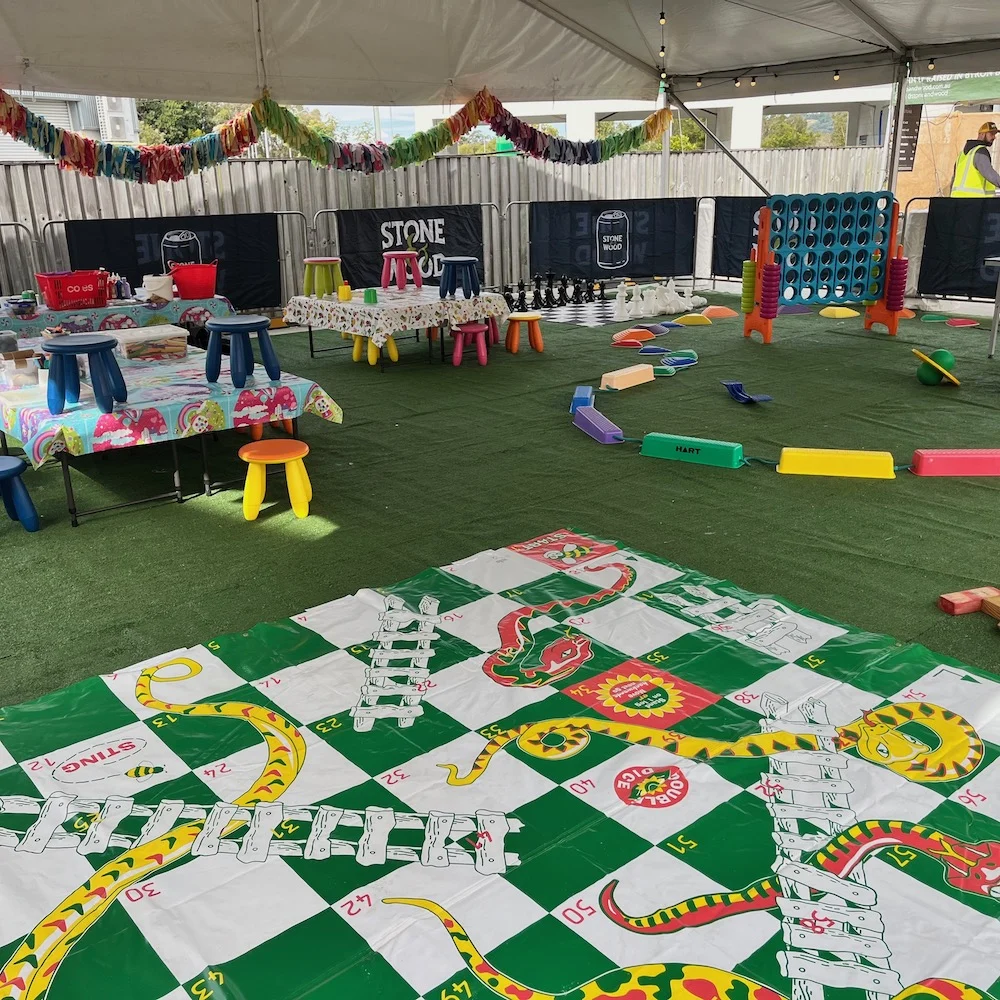
A well-run event childcare space looks calm from the outside. Children moving naturally between activities, parents relaxed at drop-off, staff visibly in control of the environment. That calm isn’t accidental. It’s the result of a deliberate setup that combines specific zones, carefully chosen equipment, and a structure designed to support how children actually behave in a temporary environment.
This post is a look inside that setup. We’ve written separately about why event childcare is different from regular care; this is the practical companion piece covering what we actually build into the space.
Why Zones Matter
Within any reasonably sized event childcare space, smaller defined zones are essential. Children arrive with different preferences, energy levels and emotional states, and those shift quickly through the day, particularly for younger children.
A space without internal structure forces every child into the same mode at the same time. Defined zones let children move between higher energy play, creative or focused activities, and quieter areas to reset. That provides choice, reduces overwhelm, and creates a more balanced environment.
It also makes the space easier to staff. Different zones naturally distribute different types of engagement, which means staff aren’t trying to manage every kind of need in the same square metre.
The Zones We Build Into Every Setup
Our event childcare environments are structured into multiple zones, each supporting a different type of engagement. Across most setups, this includes:
- A nappy change and food preparation area, kept separate from play zones for hygiene and supervision reasons
- A children’s eating space with appropriate seating and supervision sight lines
- Craft tables for open-ended creative play, with materials available for different ages
- A rest area with bean bags, books and a quiet cubby where children can step out of the main activity flow
- An active play zone with balance beams, stepping stones, foot pods, balls and hoops
- Imaginative play resources including dress-ups, puppets, dolls and role play materials
- Structured activity kits like LEGO, puzzles, board games and interactive resources for focused engagement
- Music and movement programming through the day, with a projector available for group rest periods when appropriate
Each zone is selected to support a different mode children move between, with enough variety to suit different ages and personalities arriving on the day.
Equipment Shapes the Environment
Equipment isn’t just about having activities available. It’s about how those activities support movement, creativity and self-regulation across a full day. Children need to be able to stay engaged for longer than a few minutes, transition between different types of play, and find their own balance between activity and calm.
Poorly chosen equipment leads to short bursts of engagement followed by frustration or overstimulation. Children burn through it quickly, lose interest, and the space starts to feel unsettled.
In event settings, equipment needs to be safe for a range of ages, flexible within a temporary environment (no permanent fittings, often packed down at the end of the day), and open-ended where possible. Open-ended materials, a basket of fabric, a pile of LEGO, a stack of art supplies, get used in dozens of ways across a day. Single-purpose toys get used once and discarded.
Creative Versus Active Engagement
The split between creative and active engagement is one of the most important design decisions in any event childcare space.
Active zones support energy release. Running, jumping, climbing, throwing, moving the body. These are essential for regulation. A child who hasn’t moved their body for hours becomes hard to engage no matter what activity is offered.
Creative zones support absorption and self-direction. A child who’s deep in a craft activity is in a different state from a child running outside, but both are forms of regulation. Children naturally rotate between these states through the day, and the space needs to support that movement.
A space heavy on either side runs into problems. Too active and children become wired and unable to settle. Too quiet and they become restless and disengaged. The mix is what makes it work.
The Rest Zone Is Doing Real Work
The rest zone often gets undervalued because it doesn’t look like much: a few bean bags, some books, a quieter corner. From the outside it can seem like dead space.
In practice it’s one of the most important zones we build. Children need somewhere to go when they’re overstimulated, tired, or just need to be away from the main group for a bit. Without that option they push through, become unsettled, and the staff spend the rest of the day managing the consequences.
For group rest periods, a projector with age-appropriate content can be useful as a way to bring energy down across the whole space without forcing individual children to “rest” on demand. The key is offering the option, not imposing it.
Flexibility Within the Setup
Every event is different. The space we get, the number of children, the age mix, the duration, and the surrounding event environment all influence how we configure on the day. We arrive with a setup framework rather than a fixed template, and adjust based on what the venue gives us and what the children need once they’re in the space.
The zones above are the foundation. The proportions, the specific materials, the layout, all of that flexes around the brief. A wedding kids zone looks quite different from a music festival activation, even though the underlying structure is the same.
For an example of how this plays out at scale, the Mini Mooland activation at Groovin the Moo shows how zones, equipment and design choices come together in a festival environment.
What the Setup Achieves
When a space is built this way, it does more than entertain children. It supports:
- Longer attention spans across the day, with children re-engaging rather than burning out
- Calmer transitions between activities, since children move themselves rather than being moved
- Reduced staff load, since the environment is doing some of the regulation work
- More confident parents at drop-off, because the space visibly looks well-considered
- A better experience for the surrounding event, since children are settled rather than disruptive
None of this is visible from the outside. It just looks like a well-run kids space. Which is the point.
Talk to Us About Your Event
Kidzklub delivers event childcare, wedding childcare, and full festival kids zones across Australia. Every setup is designed around the specific event, with the zone structure, equipment and staffing tailored to the venue, audience and duration.
Get in touch to discuss how a properly designed children’s space could work at your event.